
IntroToCryptos.ca
The Monkey Trap That Kept Me Holding Bitcoin Too Long

Have you ever known you were supposed to exit a trade… but your hand just wouldn’t let go?
I have.
More times than I care to count.
There is an old story about catching a monkey with a jar.
The opening is just large enough for the monkey to slide its empty hand inside. There is food in the jar.
The monkey grabs the food.
Now its fist is too large to pull back through the opening.
All it has to do is let go to be free.
But it’s hungry so it won’t.
That is the trap.
And for years, that was me trading.

The Trade Wasn’t Holding Me. I Was Holding the Trade.
I used to think my biggest trading problem was finding better entries.
It wasn’t.
One of my biggest problems was letting go when the evidence changed.
The market would turn.
My trading plan would start flashing warnings.
I would still find reasons to hold.
Maybe it will bounce.
Maybe this is just a correction.
Maybe I am selling at exactly the wrong moment.
You probably know the feeling.
That is trading psychology in its simplest form.
The position isn’t physically trapping you.
Your clenched fist is.
This Is Why I Have Journaled My Trading for Years
I have been writing down charts, observations, mistakes and trading decisions day after day for roughly ten years.
That sounds excessive until you understand what I was trying to see.
Patterns in price can develop quickly.
Patterns in your own behaviour can take years to recognize.
Then there is another problem.
Even after you recognize them, it can take months to see whether a particular decision was actually correct.
That delay is one reason trading takes so damn long to learn.
Today’s chart is a good example.
My course lesson on keeping a trading journal teaches exactly this: write down what you thought at the time, then return later and compare it with what actually happened.
Hindsight becomes useful when you have something honest to compare it against.
Look at the October Chart
Go back to the October 12 chart.
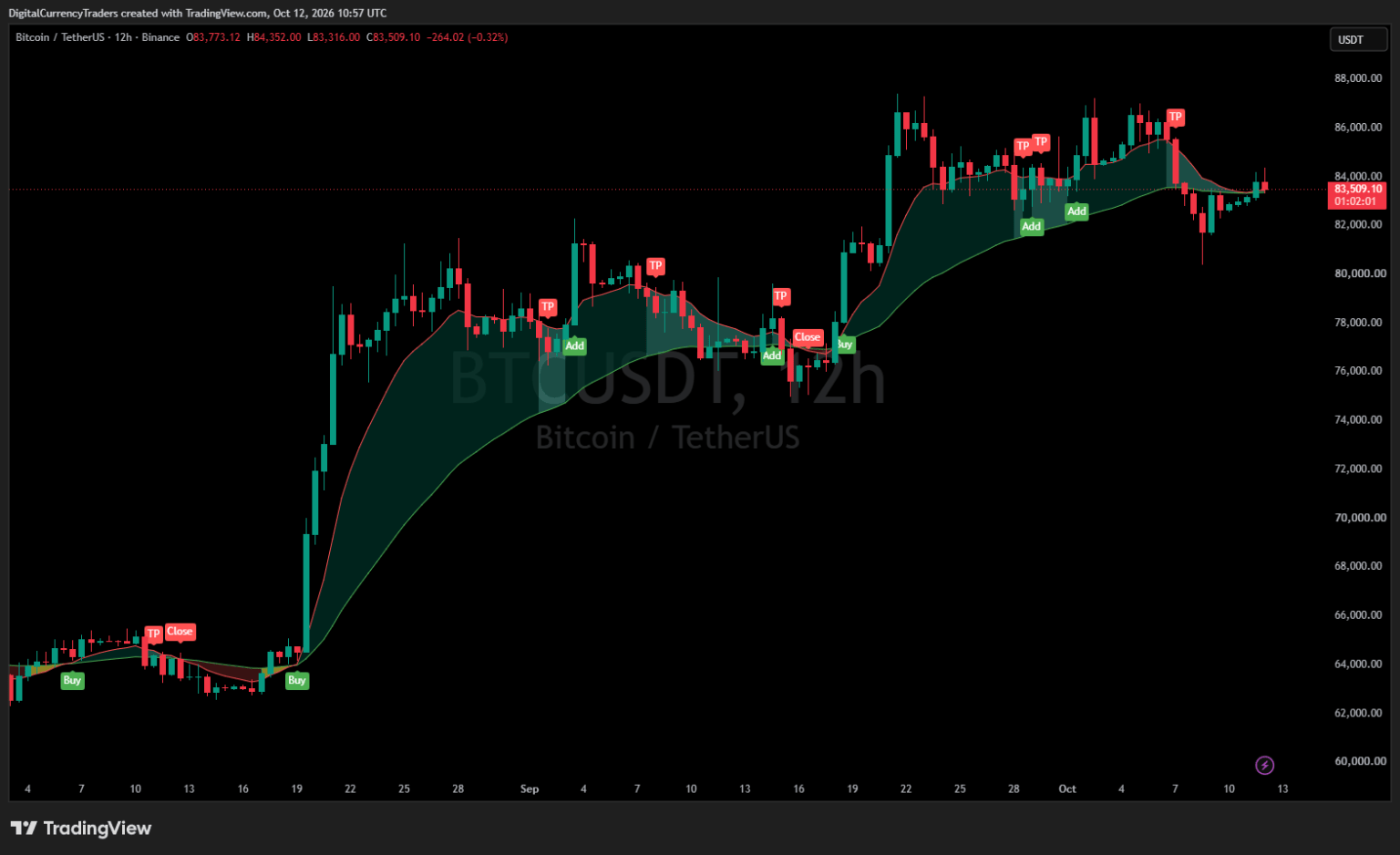
Bitcoin was around the $83,000 area.
The EMA system had already shifted into its exit state.
And emotionally, that can be an awful place to sell.
There had been rallies.
There had been recoveries.
Bitcoin had repeatedly punished anyone who became bearish too early.
The human part of my brain could make a hundred arguments for waiting.
But the system didn’t have an argument.
It had a rule.
Exit.
This is the same problem I teach in the two mistakes every trader makes.
Being wrong and losing too much is one mistake.
Being right and then interfering with the trade is the other.
The Monkey Trap lives right between them.
Now Look at the Same Chart in November
Today’s chart is very different.
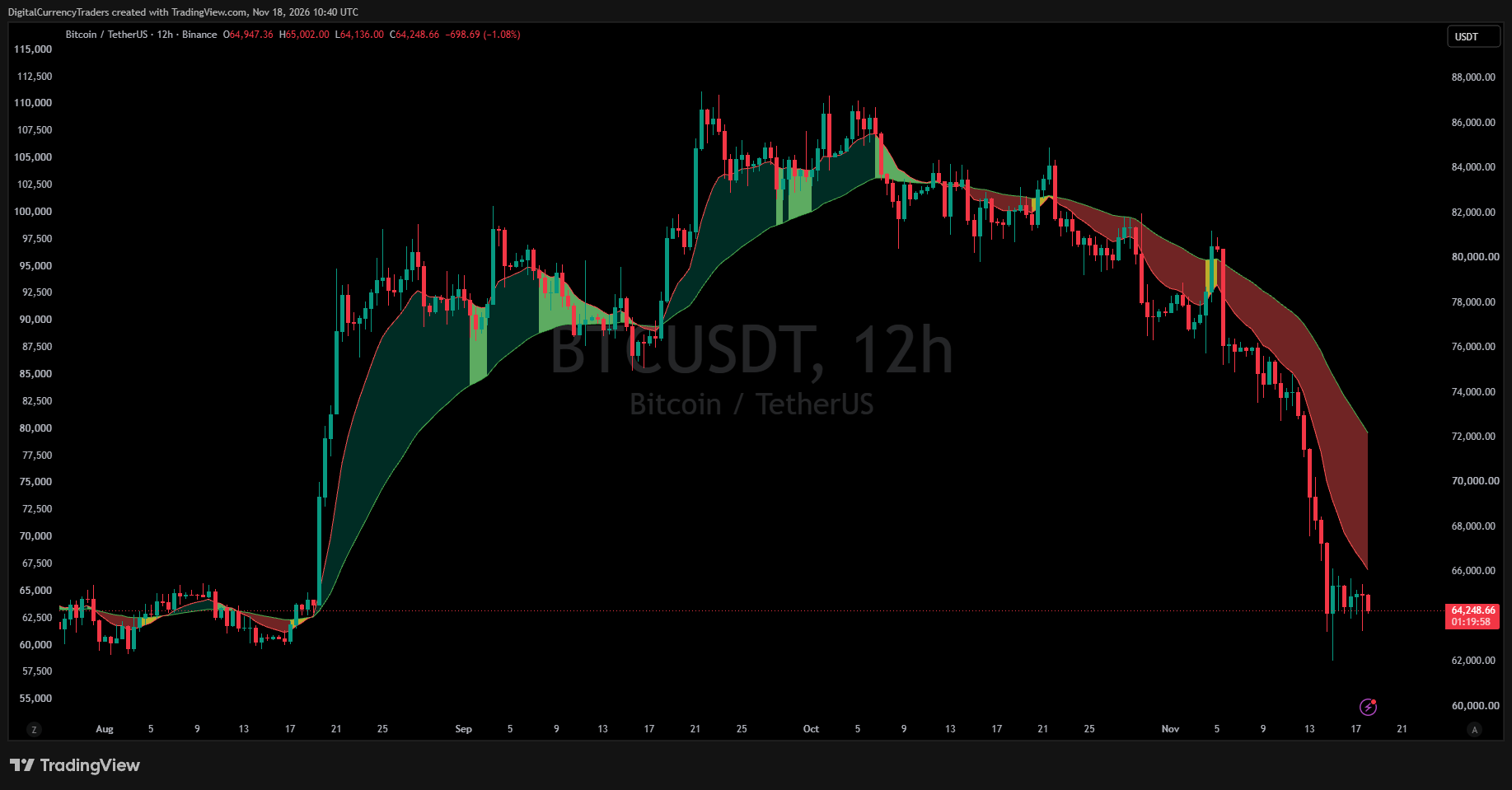
Bitcoin is around $64,500.
The EMA structure remains clearly bearish on this 12-hour chart.
I don’t need to predict where Bitcoin goes next.
I don’t know.
We’ll see.
The lesson is what has already happened between these two screenshots.
Had capital moved to cash when that exit appeared, that cash would now purchase substantially more Bitcoin than it could around the October exit.
That changes how I look at the trade.
Most people measure their portfolio only in dollars.
I am increasingly interested in asking a second question:
How much Bitcoin does the portfolio represent?
That is a very different measuring stick.
Cash Can Gain Against Bitcoin Without Earning a Dollar
This took me a long time to really absorb.
Imagine I exit Bitcoin into cash.
The cash doesn’t earn anything from the trade.
It just sits there.
Then Bitcoin falls.
Measured in dollars, my cash balance hasn’t changed.
Measured in Bitcoin, something important has happened.
That same pile of cash can now buy more Bitcoin.
So its Bitcoin-denominated value has increased.
That doesn’t mean cash magically produced a profit.
It means the denominator changed.
This is the same relative-value idea behind my work comparing ALT/BTC ratios with ALT/USD prices.
Two things can be falling in dollars while one is still gaining relative to the other.
Once you start seeing the market this way, some movements that looked invisible before become obvious.
The Monkey Wants to Grab the Bananas Again
Here is where the trap gets sneaky.
When Bitcoin falls this far, the urge changes.
Before, the monkey wouldn’t let go.
Now the monkey wants to grab again.
“It’s down so much.”
“It has to bounce.”
“This must be the bottom.”
Same monkey.
Different banana.
My trading plan doesn’t get to change just because the emotional argument changed.
For the full manual method, an entry requires the confirmations I teach in the 1-2-3 trend change formation, along with the trendline and confirming EMA crossover.
The automated systems are simpler.
They respond to their EMA crossover rules.
Neither approach needs me to guess the bottom.
That matters.
Because I have spent decades proving to myself how expensive my guesses can become.
The Rules Don’t Need to Know the Future
This is the part I missed for years.
I wanted the trading system to tell me what Bitcoin was going to do.
That isn’t its job.
Its job is to tell me what I am supposed to do when the evidence changes.
Those are completely different things.
Phantom of the Pits Rule #1 starts with the assumption that I may be wrong.
The position has to prove itself.
If it doesn’t, I reduce it or remove it.
Rule #2 is the other side of the same discipline: when a trade proves itself, I have to give the winner room rather than grabbing a tiny profit because I am scared of losing it.
I go deeper into those rules in my lesson on Phantom of the Pits risk control.
Both rules require letting go.
Let go of the loser.
Let go of the need to grab the winner too early.
Let go of needing to know what happens next.
Ten Years Later, I Finally Understand the Jar
The Monkey Trap used to destroy me because I thought discipline happened in the moment.
It doesn’t.
Discipline gets built long before that moment.
Write down the plan.
Write down what you see.
Follow the rule.
Come back months later.
Compare what you thought would happen with what actually happened.
Then do it again.
And again.
And again.
That is why I still journal these charts.
Some lessons don’t reveal themselves the next morning.
Sometimes the chart needs weeks.
Sometimes months.
Sometimes you need to make the same stupid mistake enough times that one day you finally recognize the jar while your hand is still inside it.
That’s progress.
Not predicting the market.
Recognizing myself.
If you have ever watched yourself hold a position long after your own plan told you to get out, start with my free lesson on keeping a trading journal. Write down today’s chart, today’s reasoning and today’s emotions. A few months from now, that page may teach you more than another hundred predictions ever could.
This is my system and my experience, not financial advice. Do your own research and manage your risk.
Trade safe, and keep those losses small. Cheers.
Discover more from introtocryptos.ca
Subscribe to get the latest posts sent to your email.


You must be logged in to post a comment.