
IntroToCryptos.ca
Altcoin Season Relative Strength Filter Reveals Early Movers

What if one-third of the altcoins you’re tracking have already given their entry signals, but you’re still waiting for the cryptocurrency market to turn around?
That’s the strange situation I’m watching right now.
Two weeks ago, I started writing about a hidden divergence between altcoins measured against the US dollar and those same coins measured against Bitcoin.
At first, it was just a handful of exceptions.
Now the difference is getting harder to ignore.
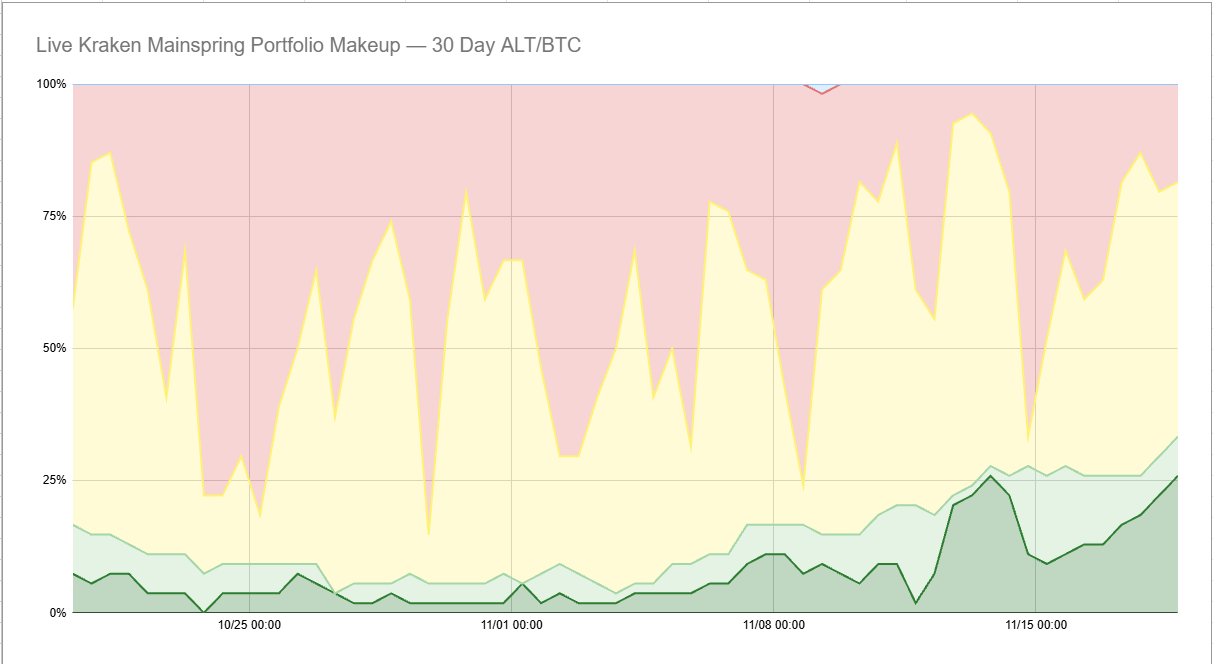
As of November 19, my live Mainspring Portfolio Manager has 18 of its 54 enabled coins in positions.
That’s one-third of the tracked basket.
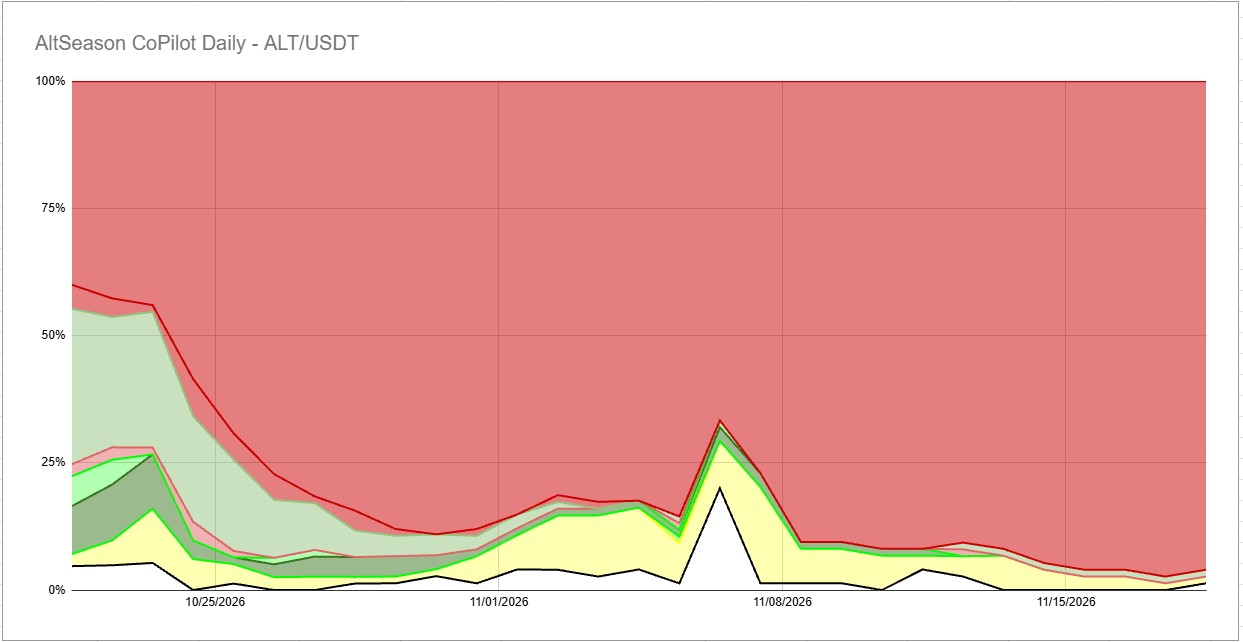
Meanwhile, my dollar-based AltSeason CoPilot dashboard is still overwhelmingly showing Exit states.
Two measurements of the same cryptocurrency market.
Two very different pictures.
And one important question.
What happens when you’re still waiting for the market to look good, but the first opportunities have already passed?
The Baseball Game Has Already Started
I’ve spent more than 25 years trading, and one mistake has cost me more times than I care to remember.
Waiting until I felt confident.
I’d watch a chart. See a potential bottom. Wait for another confirmation.
Then another.
By the time I finally felt comfortable, the opportunity I was originally watching had often passed.
Here’s how I think about it now.
Imagine standing at home plate.
The pitcher throws the ball.
You have one specific window to swing.
Too early, and you’re guessing.
Too late, and the ball is already behind you.
You can’t chase it around the bases and pretend you’re still standing at home plate.
➤ Your time to swing is when the ball crosses the plate.
Now imagine watching 54 different baseballs coming toward the plate, each arriving at a different time.
Eighteen have already crossed their entry thresholds.
That doesn’t mean the remaining 36 will follow.
➝ But the first 18 opportunities have already happened.
And that’s why timing matters.
Not because I know what the market will do tomorrow.
Because an entry signal is an event, and once it passes, chasing it afterward is no longer following the same plan.
The Hidden ALT/BTC Momentum Is Becoming Visible
Look at the two portfolio charts.
My AltSeason CoPilot tracks roughly 70 altcoins against the dollar-based market.
The overwhelming majority are still showing Exit states.
If that were the only measurement I watched, I’d see a market that still looks pretty miserable.
Now look at the ALT/BTC portfolio.
Instead of measuring each altcoin against dollars, Mainspring Portfolio Manager calculates its value relative to Bitcoin.
This reveals something the dollar charts can hide.
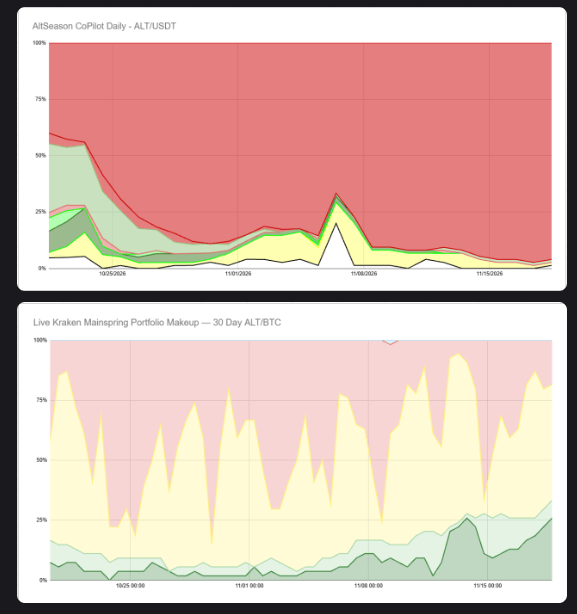
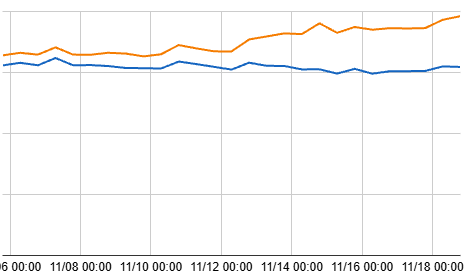
An altcoin can be falling in dollar value while gaining strength against Bitcoin.
If Bitcoin falls faster than the altcoin, the ALT/BTC ratio rises.
That doesn’t mean the altcoin is profitable in dollars.
It means it’s outperforming Bitcoin.
And when I’m measuring my portfolio in satoshis as well as dollars, that distinction matters.
I’ve been documenting this difference between ALT/USD and ALT/BTC as the two filters move farther apart.
The point isn’t that all altcoins are recovering.
They aren’t.
The point is that some individual altcoins are already behaving differently from the crowd.
The Bell Curve Doesn’t Wait for Everybody
This is where my long-tail portfolio strategy comes in.
I don’t expect 54 coins to reverse direction on the same day.
I expect individual markets to move through their own patterns at different times.
Think of a bell curve.
A few observations appear at one extreme.
Then more arrive through the middle.
Others arrive much later.
And some never qualify at all.
That’s the way I think about tracking a diversified basket of independent signals.
The early group doesn’t guarantee that the middle group will follow.
But if I’m waiting until the middle of the distribution has already passed before I start paying attention, I’ve missed the original signals from the first group.
This is why I built the system to be ready before those opportunities arrive.
I explain the wider approach in my lesson on building a diversified cryptocurrency portfolio.
The idea isn’t to know which coin will become the biggest winner.
It’s to have a consistent way to recognize qualifying moves without constantly second-guessing myself.
My Spider’s Web Is Already in Place
I like to think of the filter as a spider’s web.
A spider doesn’t know which insect is coming next.
It doesn’t know which direction it will arrive from.
It prepares the web.
And then it waits.
That’s what my ALT/BTC automation does.
It monitors each enabled cryptocurrency independently, calculating its ratio against Bitcoin.
Prices update hourly.
Every 12 hours, the system evaluates completed candles and responds to its EMA crossover rules.
When an individual coin qualifies, the automation acts according to that coin’s signal.
No predictions.
No guessing.
No waiting for me to feel comfortable.
My full manual trading method uses a downtrend line break, a completed 1-2-3 bottom and a confirming EMA crossover. The automation uses the EMA crossover alone.
I’ve spent years teaching the 1-2-3 trend change formation, including why early reversal formations can fail.
The web doesn’t know which signals will work.
Neither do I.
These Trades May Not Be Big Winners
Here’s the part that often gets left out of discussions about catching early momentum.
Some of these 18 positions may fail.
Some could reverse quickly.
Others may drift sideways, tie up capital and go nowhere.
The system can spend money on trading fees, spreads and repeated entries and exits without making any progress.
In my experience, a 1-2-3 setup used alone fails about eight times out of ten.
That’s why I don’t build a trading strategy around getting every entry correct.
I build it around many small attempts, responding to failures and allowing sustained trends room to develop.
The long-tail experiment asks whether a few strong performers can eventually cover the churn from all the others.
Maybe they will.
Maybe they won’t.
I’ll measure the results in both dollars and satoshis, including the losing trades and costs.
That’s the only way I’ll know.
Why the Time Urgency Is Real
Here’s what I want traders to understand about this particular moment.
When I say time is running out, I’m not predicting an explosion in cryptocurrency prices.
I’m talking about the number of original entry opportunities that have already passed.
Eighteen of 54 enabled coins are IN.
Those initial entry signals are no longer waiting to happen.
Some may form new setups later, but chasing an existing position after its entry signal isn’t the same trade.
Meanwhile, the other coins are being monitored for their own independent signals.
They may qualify tomorrow.
They may qualify months from now.
Or they may never qualify.
I don’t control any of that.
What I can control is whether my system is ready to respond when the signal arrives.
I’ve also learned that the five stages of a trade matter more than trying to pick the perfect bottom.
There is a time to watch.
A time when the entry rules qualify.
A time to manage an established position.
And a time to exit.
Missing one opportunity doesn’t mean chasing it is the solution.
It means the system needs to be prepared for the next one.
The Real Advantage Is Not Having to Chase
For years, trading took up far too much of my time and emotional energy.
I’d spend hours staring at charts, trying to figure out whether I should act.
Then I’d override my own rules because I was afraid of being wrong.
Now I’m watching a very different process unfold.
My Mainspring Portfolio Manager is tracking the relative strength of individual altcoins against Bitcoin and executing its rules without waiting for my opinion.
Eighteen positions are already IN.
The rest of the enabled basket continues to be monitored.
I don’t know whether this developing divergence will become a broad altcoin recovery or fade away.
But I do know something about my process.
I no longer have to run after a baseball that’s already crossed home plate.
The system is standing at the plate.
The bat is ready.
And when the next qualifying pitch arrives, the rules determine the swing.
If you’d like to understand how I use ALT/BTC relative strength and mechanical execution to take the daily guesswork out of managing a diversified cryptocurrency portfolio, explore my Mainspring Portfolio Manager system.
No prediction required.
Just a plan, a measurement and the discipline to follow the rules.
This is my system and my experience, not financial advice. Do your own research and manage your risk.
Trade safe, and keep those losses small. Cheers.
Discover more from introtocryptos.ca
Subscribe to get the latest posts sent to your email.


You must be logged in to post a comment.